
IDENTITY, CURIOSITY & THE ACTIVE BYSTANDER.
Recently, I attended an Active Bystander training session, not as a facilitator, but as a participant.
And it was interesting on two levels.
Firstly, I had the rare experience of being on the receiving end of a style of training I run every week—in the delegate’s seat.
Second, I found myself reflecting on moments in my own life when I’ve experienced racism or stepped in for someone else when I’ve overheard or witnessed something unkind, inappropriate, or just… off. Silence for me, would feel like complicity.
The four‑step model we were presented with looked like this:
Notice the event – witness the situation and the behaviour.
Interpret it as a problem – assume it hasn’t been resolved or diminished.
Feel responsible – empathise and recognise that not acting is still a form of action.
Possess the skills to act – confidence, courage and capability.
It’s a solid model.
But as I listened, I felt proud of myself for identifying a crucial step that wasn’t there, something I feel is essential in how we show up for one another. I think there needs to be a step 1.5, something like Check your understanding. Use curiosity to explore what you heard or saw.
“Did I hear that right?”
“Have I misunderstood?”
“What was the intent?”
“Is everyone aware of what’s happening?”
Because interpreting something as a problem requires us to first check whether it is a problem. Otherwise, we risk making things worse by intervening on assumptions rather than reality.
Identity depends on who’s around you. Identity is something I’ve spent my whole life navigating.
I’m mixed race—Japanese mother, English father. Born and educated in the UK but lived and worked in Tokyo in my early twenties, which was a formative time for exploring who I am and why I’m here. It’s also shaped how I support others in my day‑to‑day work—helping people understand their identity, purpose, impact and relationships.
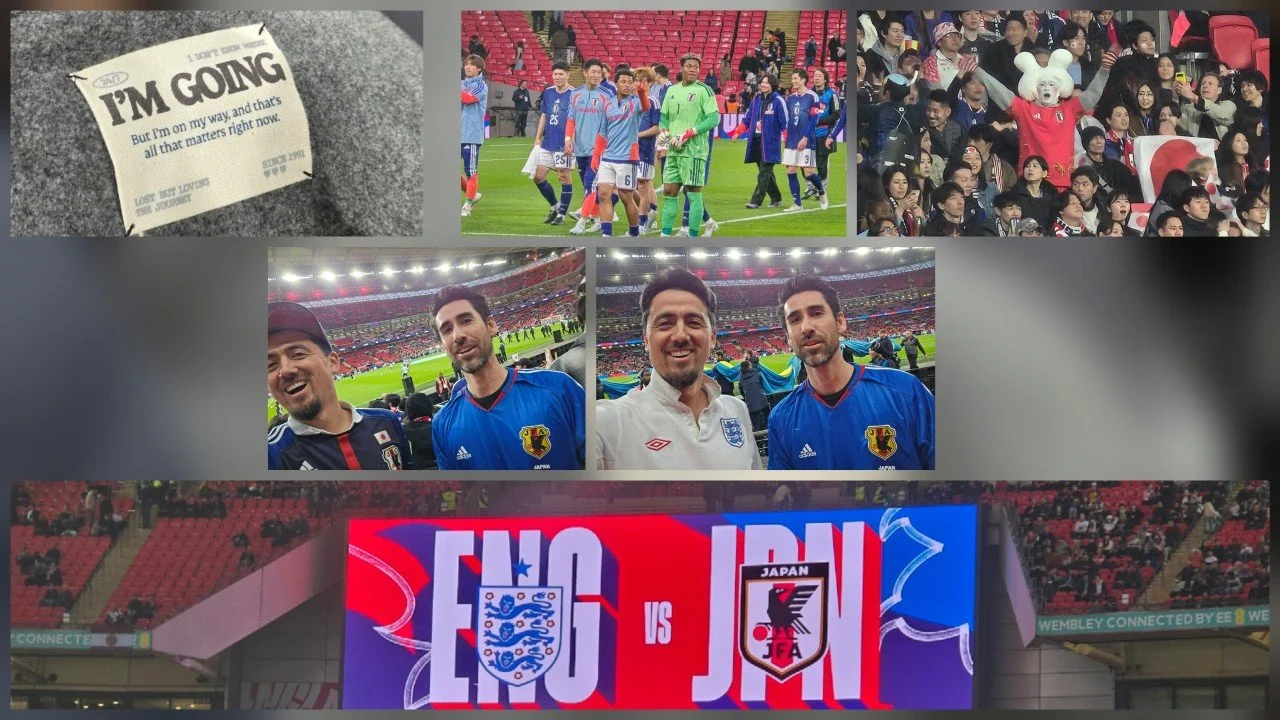
And recently, by delightful coincidence, I found myself immersed in both halves of my heritage. I travelled to Wembley to watch England play Japan in their final home game before the World Cup. I wore my Japan shirt. On the train surrounded by England fans—in the stadium, I switched shirts for ‘God Save The King’ !
It struck me again that my identity has always been relative to the people around me.
Growing up in London in the 80s and 90s, I was “Asian”, “Japanese”, often called “Chinese”, expected to be quiet, studious, compliant.
In Japanese environments, I was the “English one”, boisterous, unorthodox, noisy, funny, challenging.
Same person. Different filters.
Active bystanding, like identity, is perhaps also relational. It depends on context, on awareness, on curiosity, on our sensitivity to how others may interpret or experience a situation, especially when their identity might be seen or treated differently from ours.
Before we act for someone, we need to check in with them (explicitly or implicitly). We need to “check ourselves” so we can act with clarity, not assumption.
Identity is fluid. Contextual. Socially constructed. And our interventions, our attempts to protect, support or challenge, exist in that same fluid space.
Why This Matters
At Interaction, this is the territory we work in every day, helping people grow so organisations can thrive.
Our focus is on developing emotional intelligence, changing mindsets and enhancing behaviours, the foundations of sustainable behavioural change.
Whether it’s navigating difference, building the confidence to speak up, knowing when (and how) to intervene, or understanding who we are in relation to others—it all comes back to building the capability to notice, check, reflect and act with intention. These are the skills that underpin effective personal impact, resilience, inclusion, and positive workplace culture, all core elements of our people‑development approach.
This is the work we do as facilitators, coaches, and behavioural skills specialists and it genuinely changes how teams show up for one another.
We design our programmes in strong partnership with clients, shaping learning experiences that are outcome‑led and tailored to the real needs of your people and your organisation.
If themes like identity, inclusion, active bystanding, cross‑cultural connection, psychological safety or team performance resonate—we’re here to support your teams and help your organisation thrive.